openfoundry

The foundry for
operational intelligence.

OpenFoundry is my approach to ontology-based enterprise AI, built as a working platform rather than a paper. It turns fragmented plant and enterprise data into a governed, ontology-grounded context layer — so an agent like Apollo-1 can reason, act, and explain itself under real operational conditions.

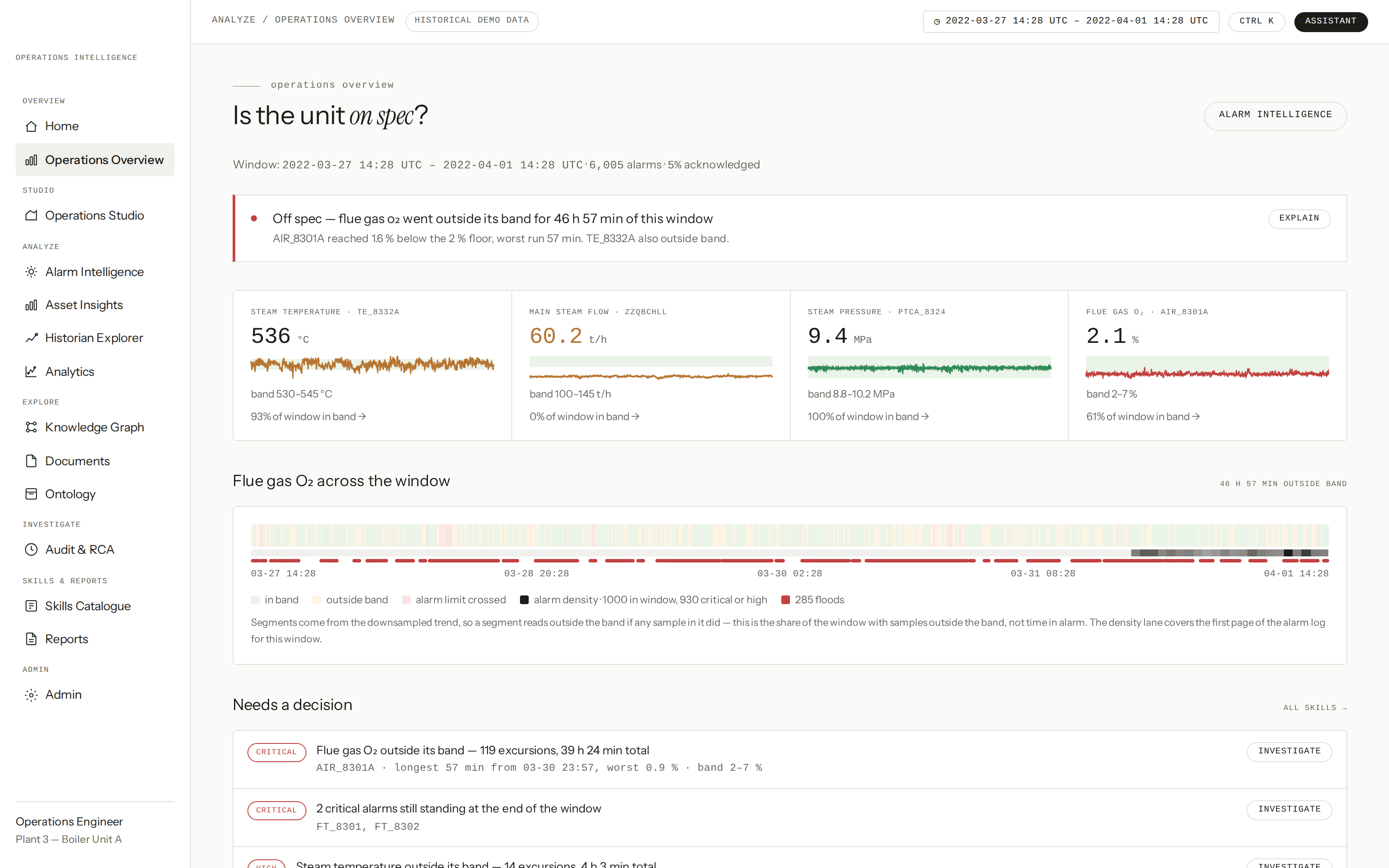
OpenFoundry Operations Overview dashboard — 'Is the unit on spec?' with KPI tiles, an off-spec banner, and a flue-gas O2 timeline
Fig. 01Operations Overview — is the unit on spec?
Grounded
Traceable
Governed
Auditable
Private
Provider-agnostic
the platform

What is
OpenFoundry?

A platform for building governed, ontology-grounded AI agents on real operational context. It takes fragmented plant and enterprise data — historians, alarms, process knowledge, documents — and structures it into a semantic layer that agents can reason over safely, with every answer traceable back to its source. The architecture is the applied form of the knowledge-graph research: five layers, each one a constraint on what the layer above is allowed to conclude.

L1Data & Documents

Historians, alarm and event logs, process documentation, business systems — ingested and mapped as they are, without forcing a rewrite of how the plant already runs.

L2Ontology & Semantic Core

Domain concepts and relationships modelled as a governed knowledge graph on open standards (OWL, RDF, SPARQL) — schema-validated, so an agent can't reason on a fact that was never approved.

L3Operational Context Layer

Equipment, processes, decisions, and rules connected into one operational model, with a traceable line from any answer back to the evidence behind it.

L4Grounded Agent Runtime

Provider-agnostic agent execution — any LLM, routed by role — reasoning only over context it can prove, never over what it assumes.

L5Governance & Audit

Every investigation — hypotheses, evidence, conclusions, corrective actions — sealed into a tamper-evident record.

the ontology layer

What may exist,
and what may connect.

The schema is not documentation — it is enforcement. Each cell in the relation matrix is a connection the editor either permits or refuses to draw, and derived relations are computed from a rule rather than authored by hand.

An agent cannot reason over a relationship the ontology never allowed to exist. That constraint is what makes the answers above it defensible.
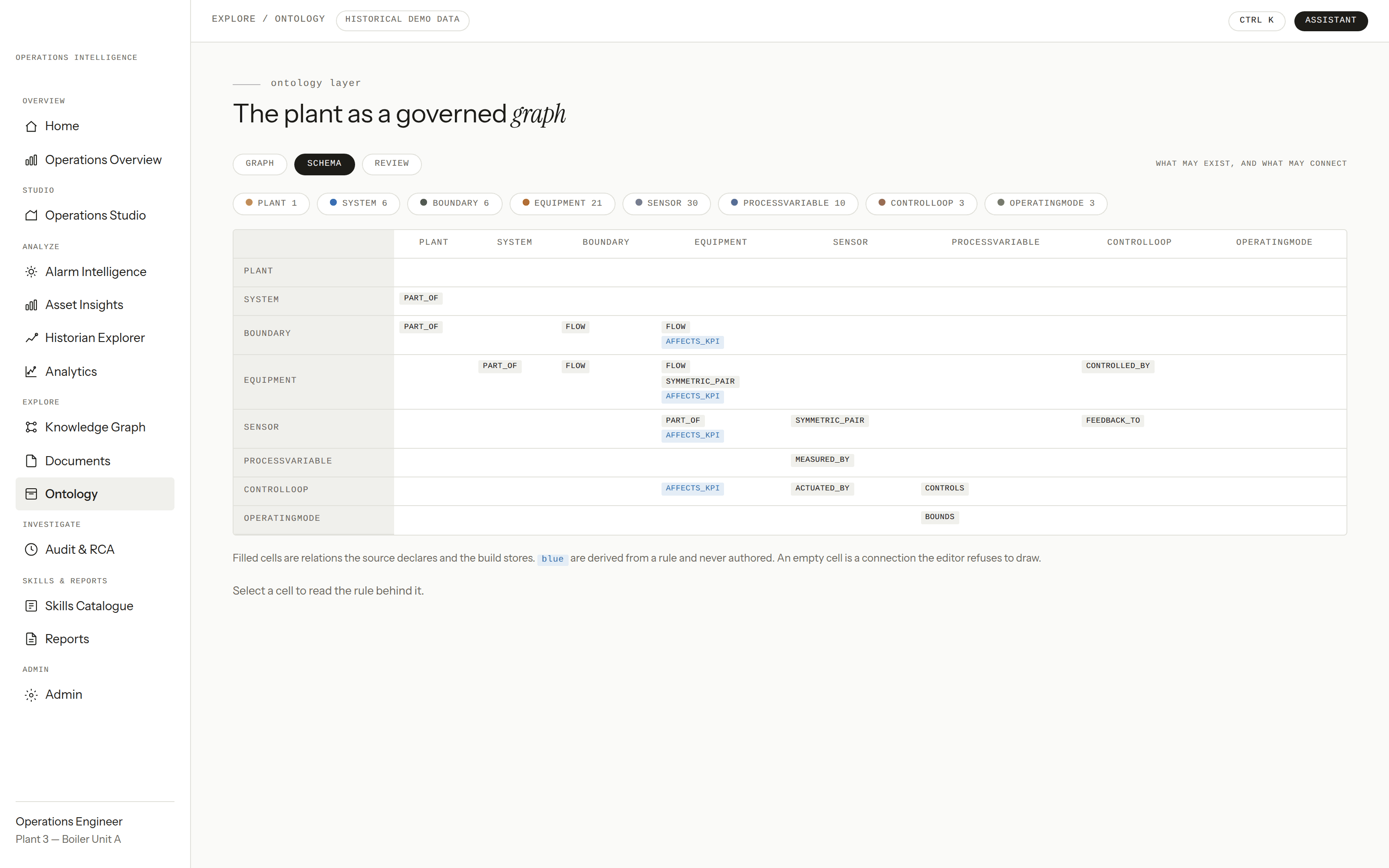
Ontology schema view showing a relation matrix between plant, system, equipment, sensor, and control-loop classes
Fig. 02Ontology — the plant as a governed graph
01

Private deployment

Runs inside your own infrastructure. No data leaves your environment. You control the models, the data, and the governance.

02

Open standards

Built on OWL, RDF, SPARQL, and open LLM architectures. No proprietary lock-in — interoperable with an existing stack.

03

Explainable by design

Every AI output is traceable to its source context. You can audit, explain, and defend every decision the system supports.

04

Governance-first

Access controls, audit logs, and approval workflows are built into the architecture from the start — not bolted on later.

capabilities

Grounded on
operational reality.

OpenFoundry agents don't answer from memory. They query the systems that already run the operation — and cite exactly what they found.
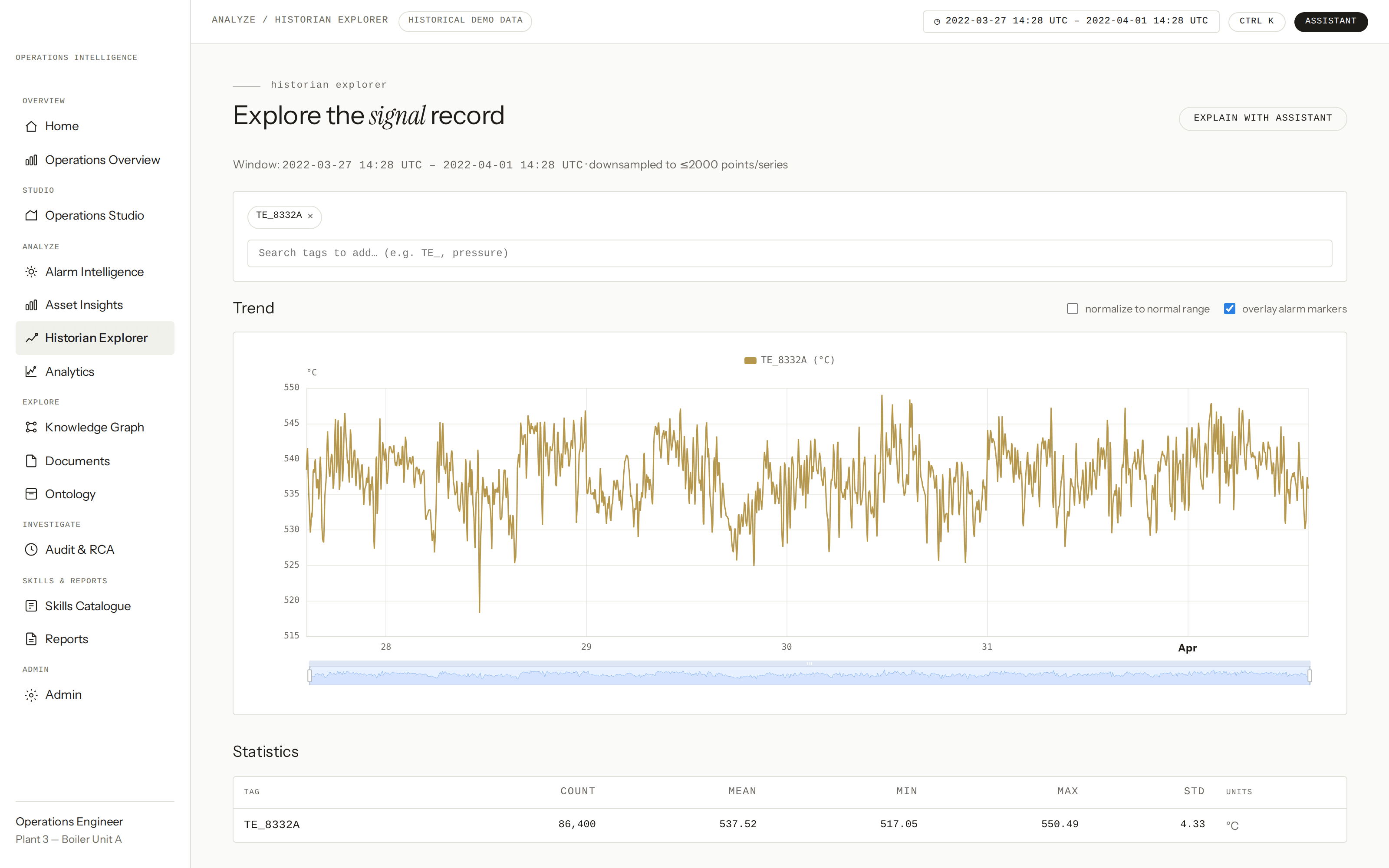
Historian Explorer trend chart for TE_8332A with normal-range band and statistics
Historian Explorer — the signal record
01

Historian & time-series

Sensor trends, statistics, and normal-range bands with alarm markers overlaid — queried in plain language instead of tag codes.
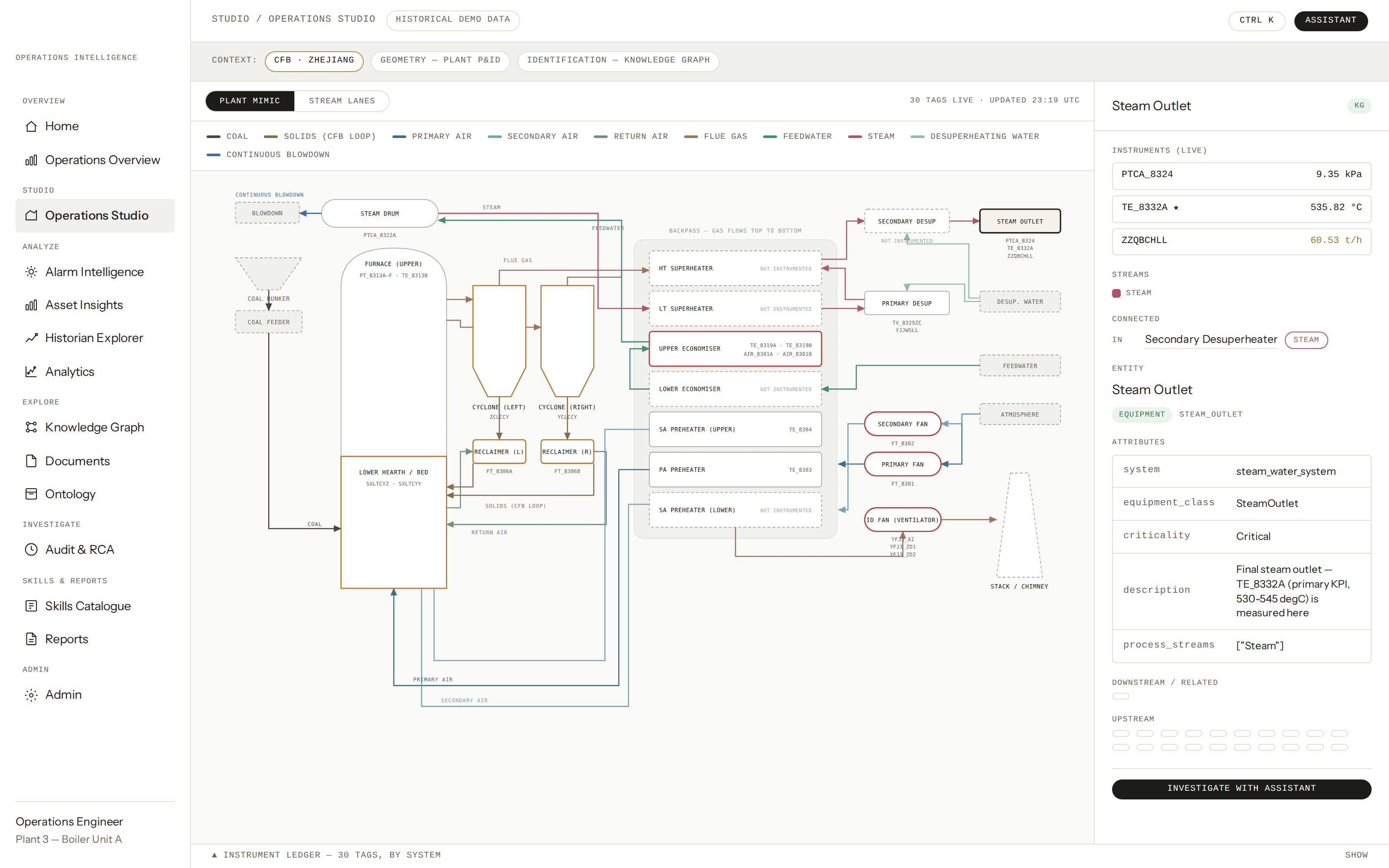
Operations Studio plant mimic diagram with a live entity inspector for the steam outlet
Operations Studio — the plant as a live mimic
02

Operations Studio

The plant as a live mimic — every stream, sensor, and equipment node connected to the knowledge graph, with a live entity inspector one click away.
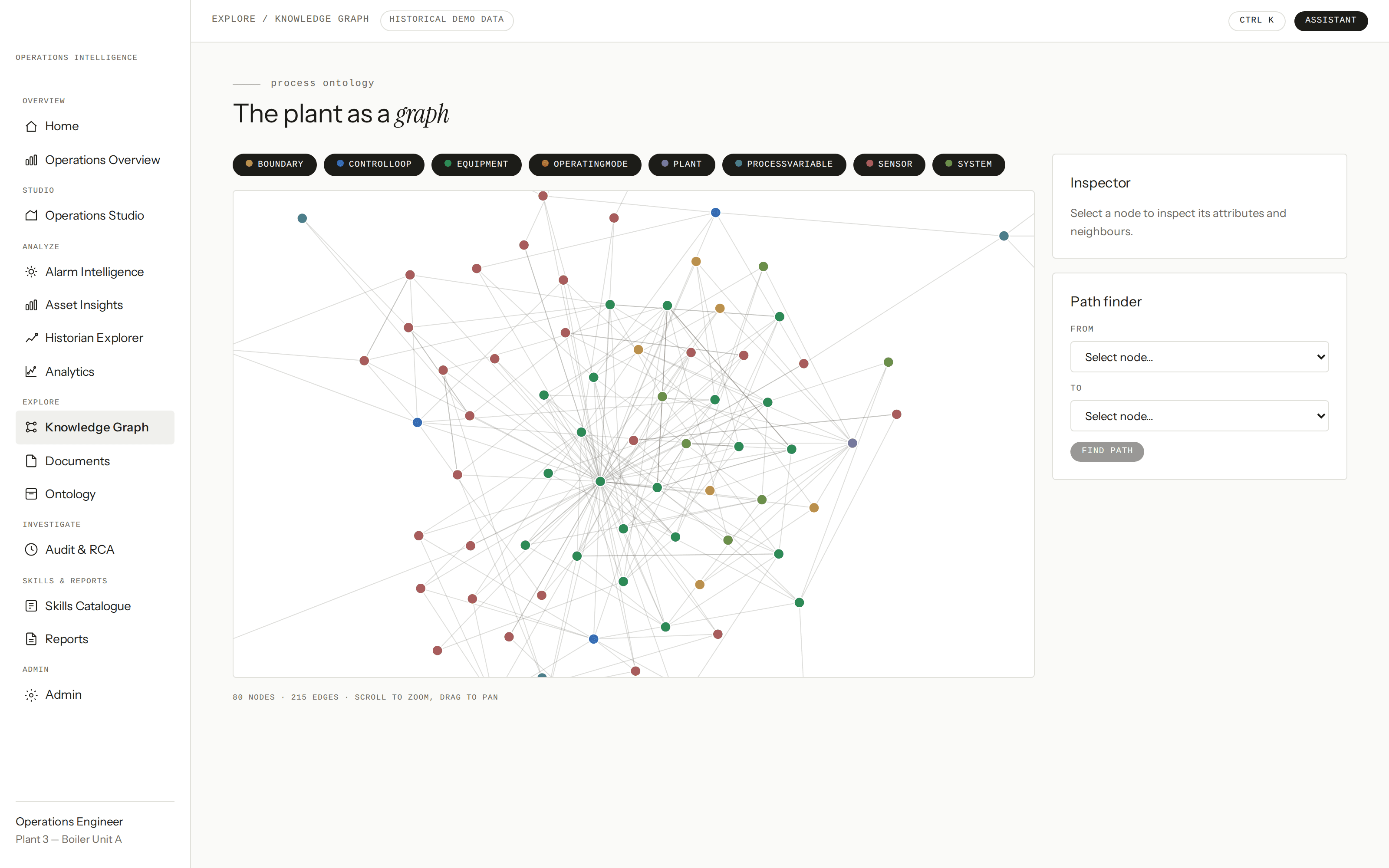
Force-directed process knowledge graph with 80 nodes coloured by type
Knowledge Graph — the plant as a graph
03

Process knowledge graph

Equipment, sensors, streams, and control loops connected into a queryable topology — upstream causes and downstream effects, traced automatically.
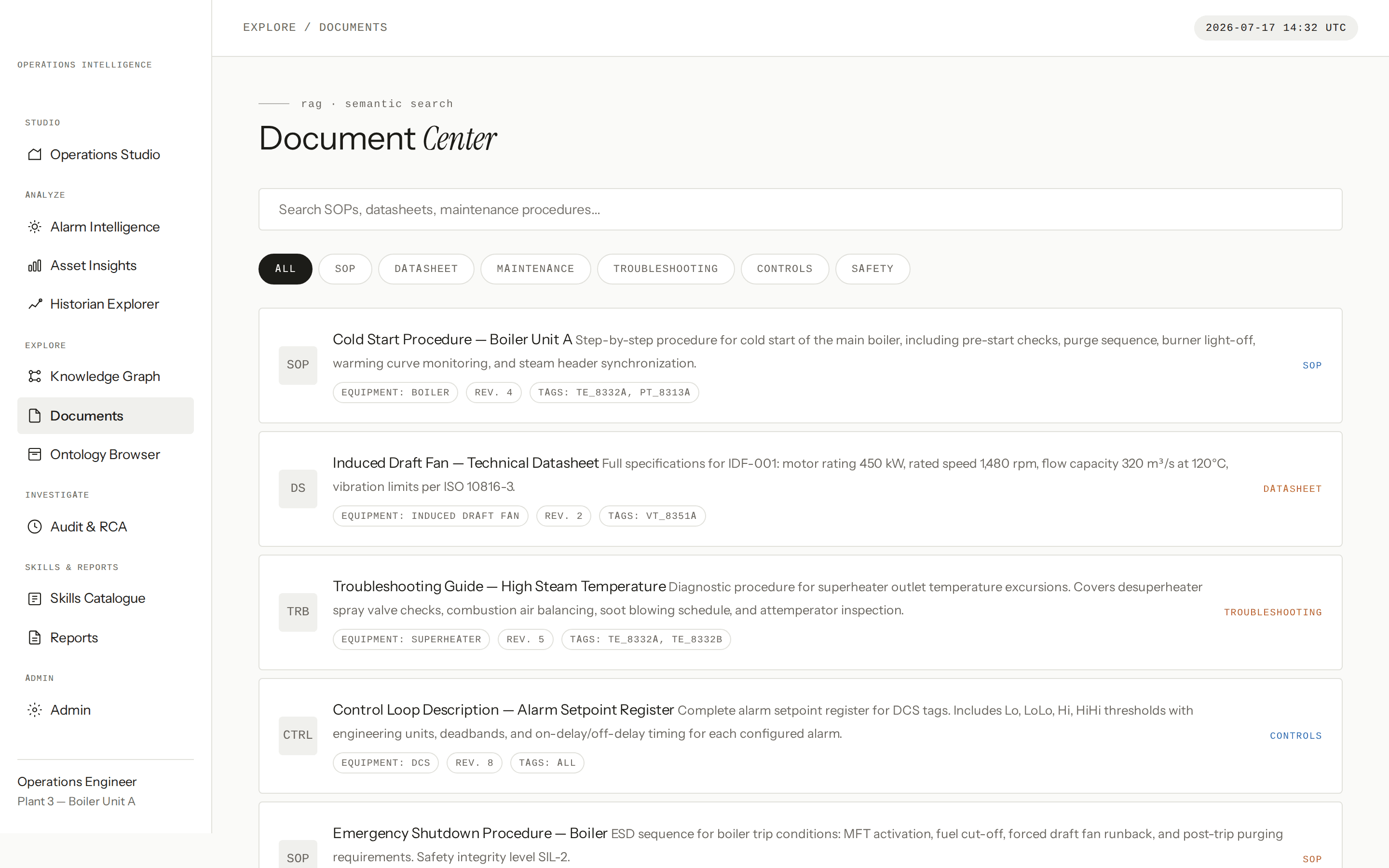
Document Center semantic search over plant procedures and datasheets
Document Center — semantic search
04

Engineering documents

SOPs, datasheets, and troubleshooting guides retrieved by meaning, always cited by document title and revision.

use cases

Built for the questions
operators actually ask.

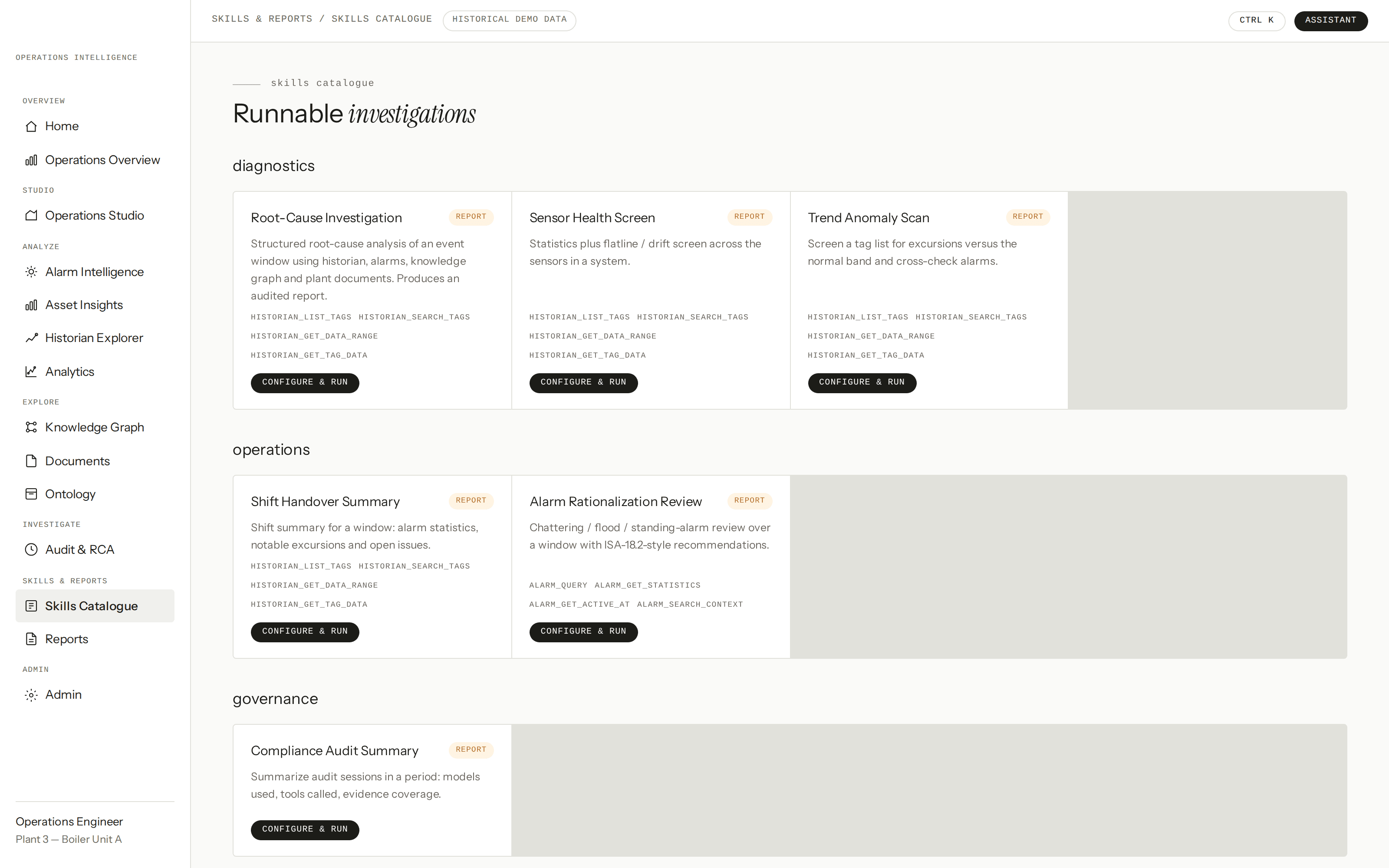
OpenFoundry ships with a growing catalogue of governed Skills — reusable, auditable agent capabilities designed to apply across manufacturing, energy and process, construction, and retail operations.
01
Root-cause investigation
Trace an anomaly to its cause across the historian, alarm log, knowledge graph, and document library.
02
Shift handover summary
Auto-generate a grounded brief of what happened, what's active, and what to watch.
03
Alarm rationalization
Surface chattering, standing, and nuisance alarms against ISA-18.2 criteria.
04
Sensor health screening
Flag flatlined, drifting, or suspect instrumentation before it hides a real problem.
05
Trend anomaly scanning
Catch statistically significant deviations before they reach a primary KPI.
06
Compliance audit summaries
Assemble evidence-backed reports against your own procedures, citing the source for every claim.
Where the pattern applies
Manufacturing
Process deviations, equipment health, and procedure compliance across production lines.
Energy & process
Boiler, turbine, and process-unit troubleshooting grounded in historian, alarm, and control data.
Construction
Project, equipment, and safety context connected for on-site and back-office decisions.
Retail
Operational and supply data structured into a context layer agents can query reliably.
Skills Catalogue of runnable investigations grouped into diagnostics, operations, and governance
Fig. 03Skills Catalogue — runnable investigations
the agent

Apollo-1

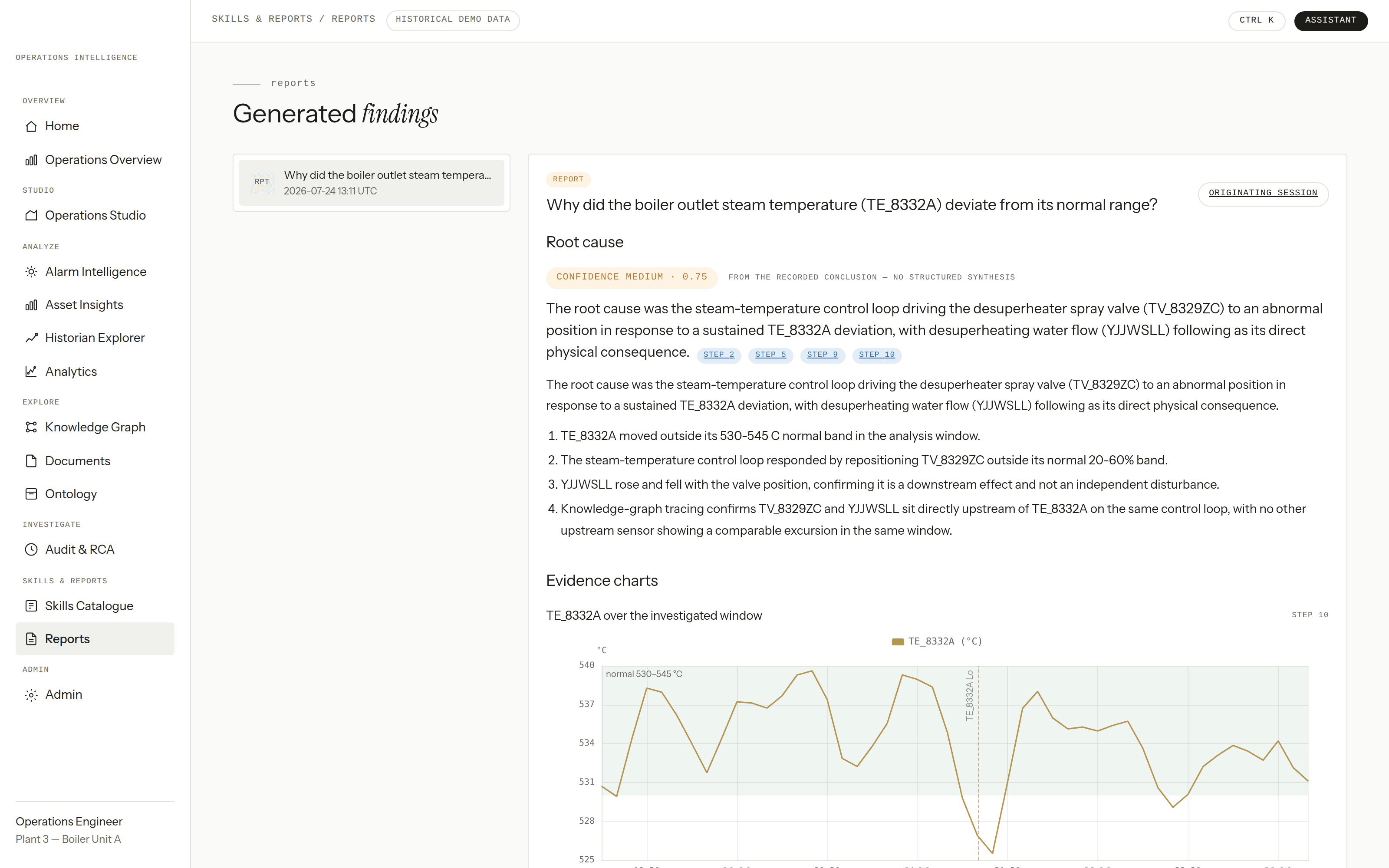
Apollo-1 is the flagship agent built inside OpenFoundry — grounded in operational context, and built to reason the way a principal engineer would: form a hypothesis, gather evidence, rule out alternatives, and only then conclude.

As a reference deployment, Apollo-1 runs against a real coal-fired boiler — investigating temperature and pressure excursions, tracing root cause across sensors, alarms, and procedure. It is the proof that the architecture holds up outside a paper: the same grounded, governed reasoning, applied to a plant that does not care what the ontology says it should be doing.
01
Investigate on evidence
Every answer traces to the historian reading, alarm, graph node, or document that produced it.
02
Reason before concluding
Hypotheses are logged, tested, and ruled in or out before any root cause is declared.
03
Explain its own work
Every investigation is sealed into a tamper-evident, auditable trace — what was asked, what was found, why.
04
Adapt to a new context
The same grounded reasoning pattern applies wherever operational context can be modelled — not just this reference deployment.
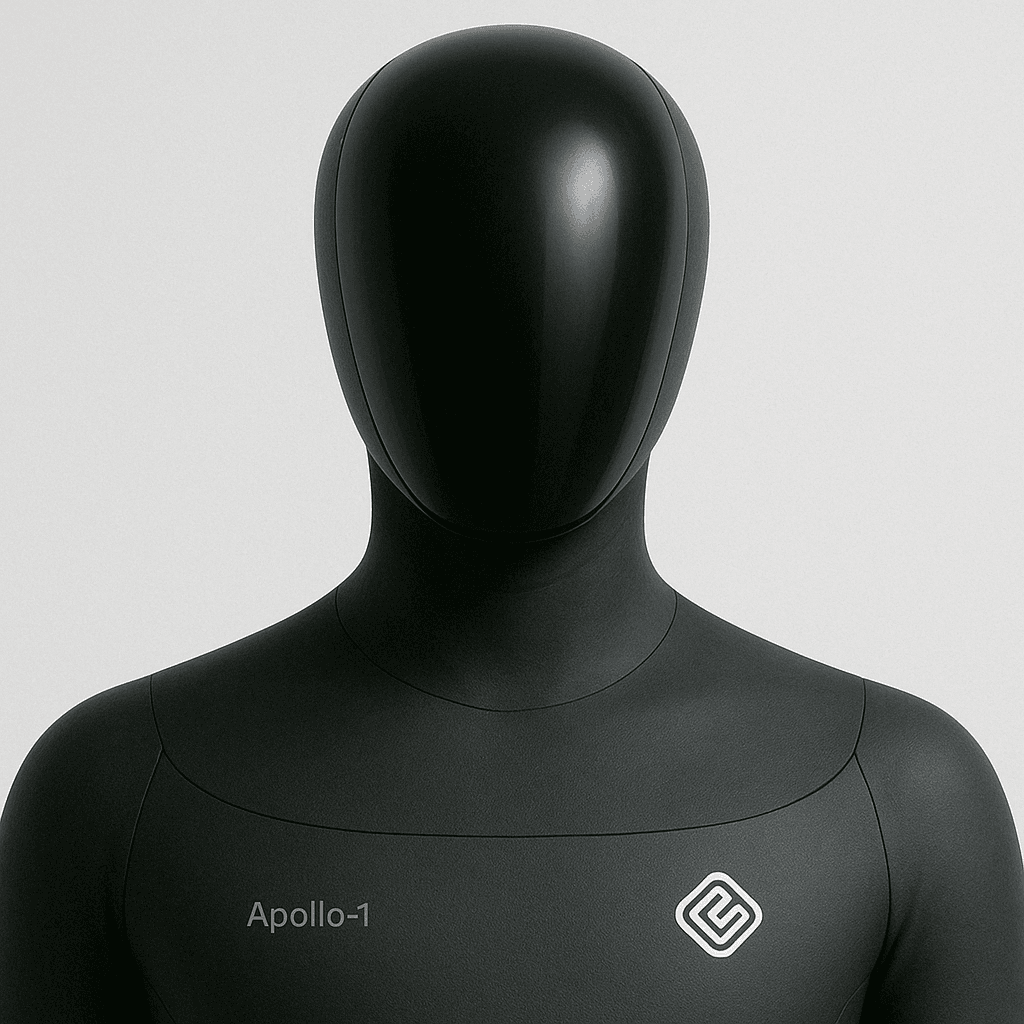
Apollo-1 agent identity
apollo-1 — agent identity
Built inside OpenFoundry, grounded on real operational context.
Reports screen showing a generated finding with root cause, evidence charts, and a confidence score
reports — generated findingsreference deployment
governance & audit

Every investigation,
sealed.

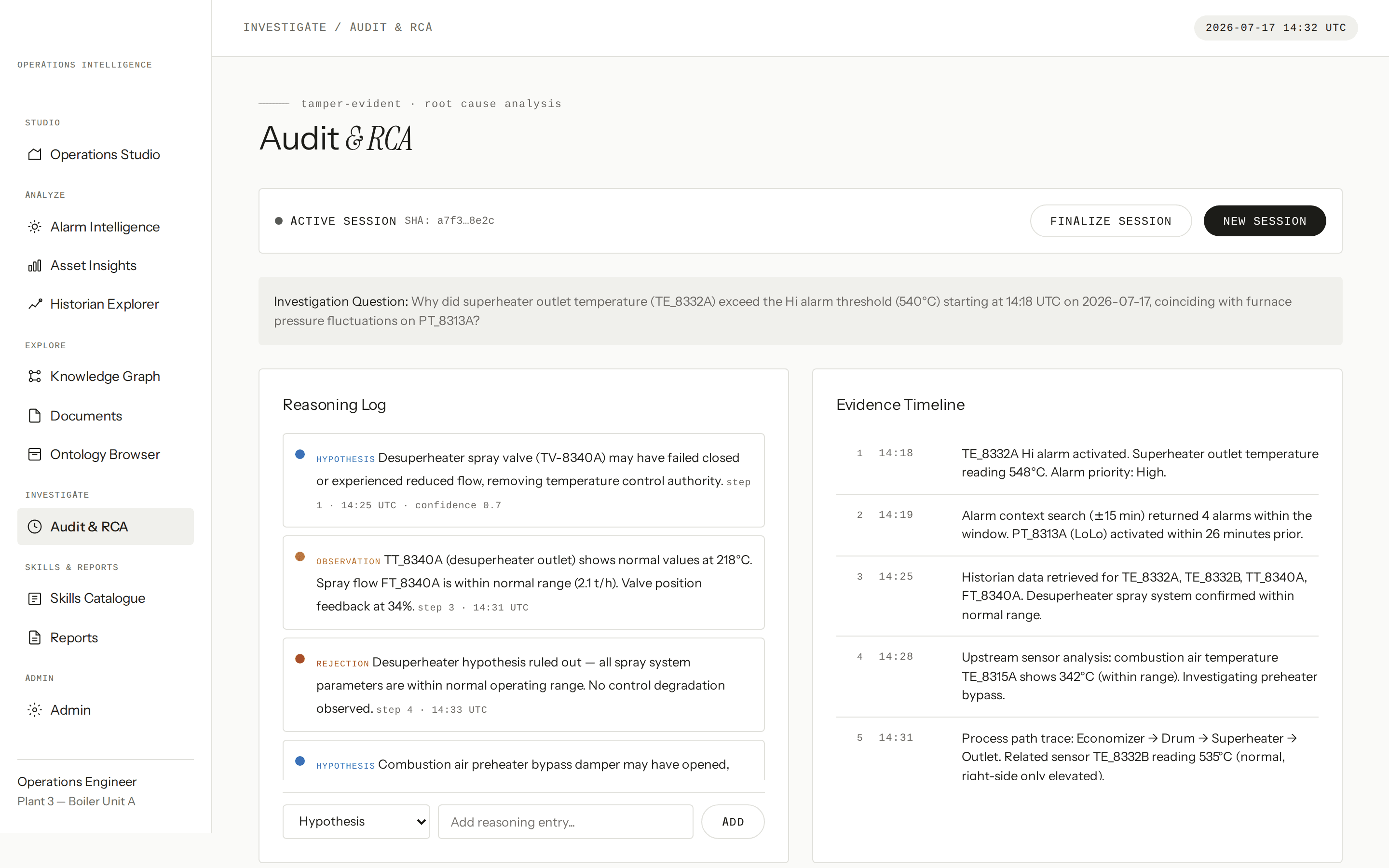
OpenFoundry is governance-first. Ontology changes flow through schema validation before they reach an agent. Every investigation — hypotheses, evidence, conclusions, corrective actions — is sealed into a tamper-evident record, so nothing is re-written after the fact.
Governed ontology changesets
Every change to the knowledge model is schema-validated and reviewed before it merges.
Tamper-evident audit trace
Investigations are sealed into a cryptographically verifiable record — what was asked, what was found, why.
Private, provider-agnostic deployment
Runs inside your infrastructure against any compatible model — no data leaves your environment.
Audit & RCA screen showing a reasoning log with hypotheses, observations, and an evidence timeline
Fig. 04Audit & RCA — reasoning log & evidence timeline
knowledge graph

The operation,
mapped.

OpenFoundry builds a living graph of the operation — every process, system, decision, rule, and data source, connected and queryable in real time.

drag to rotate · hover to explore

connected operational knowledge network

See it in your context.

I run walkthroughs for teams evaluating ontology-grounded agents, and I'm interested in pilot deployments where the operational context is genuinely hard.